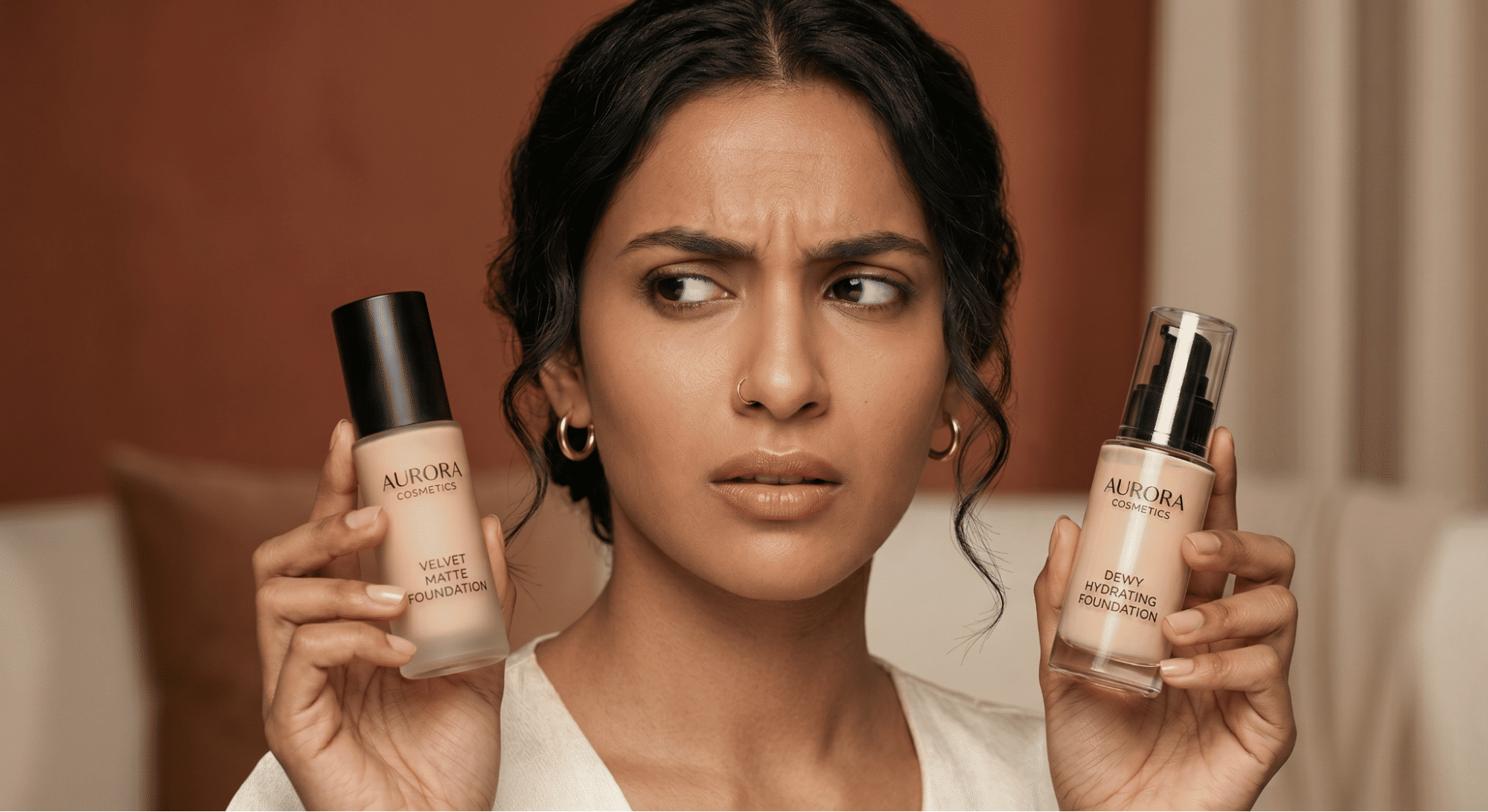
That’s usually when people realise the finish probably doesn’t suit their skin properly.
And honestly, this changes a lot depending on your skin type, your skincare underneath, the weather and how long you wear makeup.
In This Story:
- Matte Foundation Is Mostly About Controlling Shine
- Hydrating Foundations Focus More on Comfort
- Matte Doesn’t Automatically Mean Better for Oily Skin
- Hydrating Foundation Can Look Beautiful… or Too Shiny
- Your Skin Type Usually Decides the Starting Point
- Modern Foundations Feel Less Extreme Now
- Skin Prep Changes Both Finishes Completely
- Weather Changes Foundation More Than People Realise
- Extremely Matte Makeup Isn’t the Main Trend Anymore
- The Best Foundation Usually Feels Easy to Wear
- Frequently Asked Questions
Matte Foundation Is Mostly About Controlling Shine
This is why oily skin usually gets recommended matte foundation first.
Matte formulas are designed to:
- Reduce excess shine
- Stay in place longer
- Create a smoother-looking finish
- Feel less greasy through the day
And honestly, in humid weather that can feel really helpful.
Especially if your makeup normally starts sliding around by afternoon.
Soft matte finishes also tend to:
- Photograph cleaner
- Blur texture slightly
- Look more polished initially
That’s why matte foundations became so popular for long-wear makeup.
Hydrating Foundations Focus More on Comfort
This is where dry or dehydrated skin usually feels happier.
Hydrating foundations tend to:
- Feel softer on the skin
- Move more naturally with facial movement
- Look fresher throughout the day
- Leave some glow or softness behind
Instead of a flat matte look, the skin still looks slightly alive underneath.
Some people love that fresh finish.
Others immediately feel like it becomes greasy too quickly.
That’s honestly why hydrating foundation opinions vary so much depending on skin type.
Matte Doesn’t Automatically Mean Better for Oily Skin
This surprises a lot of people.
Very matte foundation can sometimes look heavy, dry around certain areas, or patchy after a few hours.
especially if oily skin is also dehydrated underneath.
That’s when makeup starts separating around the nose, clinging strangely near dry patches, and looking uneven through the day.
That’s why proper foundation skin type matching is more complicated than: “oily skin = matte foundation.”
A softer matte or balanced semi-matte finish often works better now.
Hydrating Foundation Can Look Beautiful… or Too Shiny
This depends heavily on weather and skin condition.
In dry weather, hydrating foundation usually looks smoother, feels more comfortable and gives healthier-looking skin.
But during humid Indian summers, very glowy formulas can sometimes start looking too shiny, oily around the T-zone, and heavier by evening.
That’s where texture matters more than simply “hydrating” or “matte.”
Your Skin Type Usually Decides the Starting Point
Usually:
| Skin Type | What Often Feels Better |
|---|---|
| Oily skin | Soft matte or semi-matte |
| Dry skin | Hydrating foundation |
| Combination skin | Balanced natural finish |
| Dehydrated skin | Flexible hydrating formulas |
| Sensitive skin | Lightweight skin-like textures |
Honestly, most people eventually end up somewhere in the middle instead of choosing extremely matte or extremely dewy formulas.
Modern Foundations Feel Less Extreme Now
This is why the comparison became more confusing recently.
A lot of newer formulas aren’t fully matte or fully glowy anymore.
You now see natural matte foundations, satin finishes, soft glow textures, and skin-like semi-matte formulas.
And honestly, those balanced finishes usually work better for everyday life.
Especially for long wear.
Skin Prep Changes Both Finishes Completely
This part honestly matters more than people expect.
A matte foundation on properly hydrated skin usually looks smoother, less cakey, and more natural.
While a hydrating foundation on oily overloaded skin can start looking too shiny, heavy, and slippery by afternoon.
That’s why prep changes the entire result.
Usually:
- Lightweight skincare works better under matte foundation
- More hydration helps dry skin under flexible formulas
Balanced prep almost always gives better wear.
Weather Changes Foundation More Than People Realise
Especially in Indian weather.
Usually:
| Weather Condition | What Often Feels Better |
|---|---|
| Humid weather | Soft matte finishes |
| Dry heat | Hydrating foundation |
| Winter | Flexible moisturizing formulas |
| AC environments | Skin-like satin textures |
That’s why the same foundation can feel completely different across seasons.
A formula you love in winter may suddenly feel too heavy in May.
Extremely Matte Makeup Isn’t the Main Trend Anymore
This is probably the biggest overall shift.
People still want smoother-looking skin, but not necessarily flat powdery makeup, very dry matte skin, or heavy full coverage all day.
That’s why balanced skin-like finishes became much more popular recently.
Most people now want makeup that feels comfortable, looks natural in daylight, wears evenly, and still lets skin look real.
Comfort started mattering almost as much as coverage.
The Best Foundation Usually Feels Easy to Wear
That’s honestly the simplest way to tell.
When foundation suits your skin, you stop adjusting it constantly, it fades naturally instead of separating, skin still feels comfortable after hours, and you don’t rush to wash it off.
And honestly, foundation usually looks best when it still feels believable as real skin.
Frequently Asked Questions
-
Which is better: matte or hydrating foundation?
It depends on your skin type, climate and the finish you personally find comfortable throughout the day.
-
Is matte foundation good for oily skin?
Usually yes, but overly matte formulas can still look dry or patchy if the skin is dehydrated underneath.
-
Do hydrating foundations work for oily skin?
Some lightweight hydrating foundations work very well, especially balanced or semi-matte formulas.
-
Why does matte foundation sometimes look cakey?
Usually because of dryness, excess powder or applying too much product.
-
Which foundation finish looks the most natural?
Soft matte, satin and balanced hydrating finishes usually look the most skin-like in real life.